The Playing Field Is a Classroom Too — Why Sports Facilities Are Not a School Luxury But an Educational Necessity
The lessons a child learns on a cricket pitch, a running track, or a basketball court are lessons that no textbook can teach — and the schools that understand this are producing students who are stronger in every dimension of their lives.
Ask any accomplished professional — a surgeon, an entrepreneur, a lawyer, a scientist — about the formative experiences that shaped their capacity for pressure, teamwork, and resilience, and a remarkable number of them will not mention a classroom. They will mention a sport. The early morning practice sessions. The match that came down to the final over. The defeat that hurt so deeply it became fuel. The coach who believed in them before they believed in themselves.
This is not sentimentality. It is a consistent, cross-cultural pattern that developmental researchers have documented with increasing precision over recent decades: children who participate meaningfully in sport during their school years develop a set of capabilities — emotional, cognitive, physical, and social — that their purely academically focused peers demonstrably lack. And yet, in school after school across India, sports facilities remain underfunded, underused, or absent entirely. Physical education is the subject most readily sacrificed when examination pressure mounts. The playing field is the first thing cut when budgets tighten.
This is a mistake — not merely a philosophical one, but a measurable, consequential educational error. And understanding why it is an error is the first step toward choosing a school that has got this right.
What Sport Does to the Brain — and Why It Matters for Learning
The relationship between physical activity and cognitive performance is one of the most robustly established findings in educational neuroscience. Regular vigorous exercise increases blood flow to the brain, promotes the growth of new neural connections, and elevates the levels of neurotransmitters — including dopamine, serotonin, and norepinephrine — that are directly associated with attention, memory consolidation, and executive function.
In practical terms, this means that a child who has had a genuine physical education session — who has run, jumped, stretched, competed, and recovered — returns to the classroom with a brain that is measurably more ready to learn than it was before. Attention spans lengthen. Working memory improves. The capacity to sit with a difficult problem and persist through it increases. This is not coincidental. It is physiological.
Schools that eliminate or marginalise physical education in the name of maximising academic contact time are, therefore, making a counterproductive choice. They are reducing the very conditions under which the academic learning they prioritise is most effectively absorbed. The evidence is unambiguous: more sport produces better learners, not worse ones. Cutting sport to make time for study produces neither athletic nor academic excellence — it produces fatigue, disengagement, and a slow erosion of the joy that makes learning sustainable.
The Character Curriculum That Sport Delivers
Beyond its neurological benefits, sport delivers something that no formal curriculum can prescribe but every great school recognises as essential: the lived experience of character under pressure. The qualities that parents most want their children to develop — resilience, integrity, the ability to lead and to follow, the capacity to win with grace and lose with dignity — are qualities that are tested, strengthened, and revealed most clearly in competitive physical contexts.
A child who learns to manage the anxiety of a crucial penalty kick, to support a teammate who has made a costly error, to push through the final lap when every instinct says to stop, and to shake hands with an opponent who has just defeated them is a child who is developing capacities that will serve them in boardrooms, courtrooms, operating theatres, and every other high-stakes environment they will ever inhabit.
These lessons cannot be taught through instruction. They can only be learned through experience — through the genuine unpredictability, physical demand, and emotional intensity that sport uniquely provides. A school that takes sport seriously is a school that takes character seriously. The two are inseparable.
Why Facilities Matter — and What Good Ones Look Like
Not all schools that offer sport offer it equally — and the quality of physical facilities is a meaningful signal of an institution's genuine commitment to physical education rather than its token acknowledgement. A cramped multipurpose space shared between physical education, assembly, and examination seating is not a sports facility. It is a compromise that communicates clearly where sport sits in the school's hierarchy of priorities.
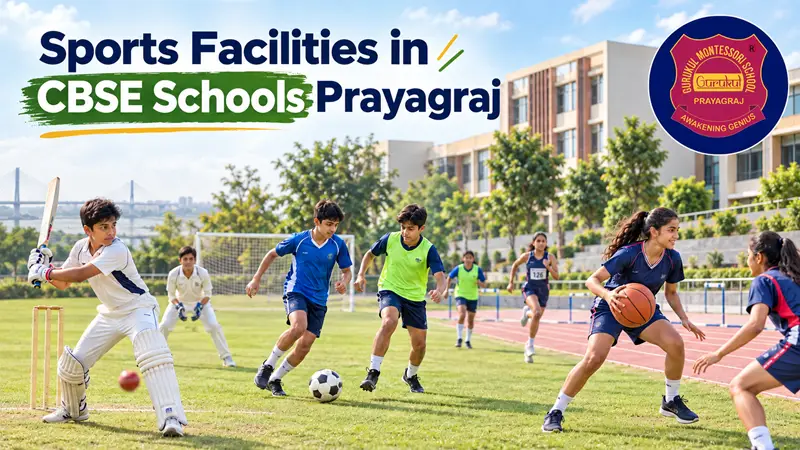
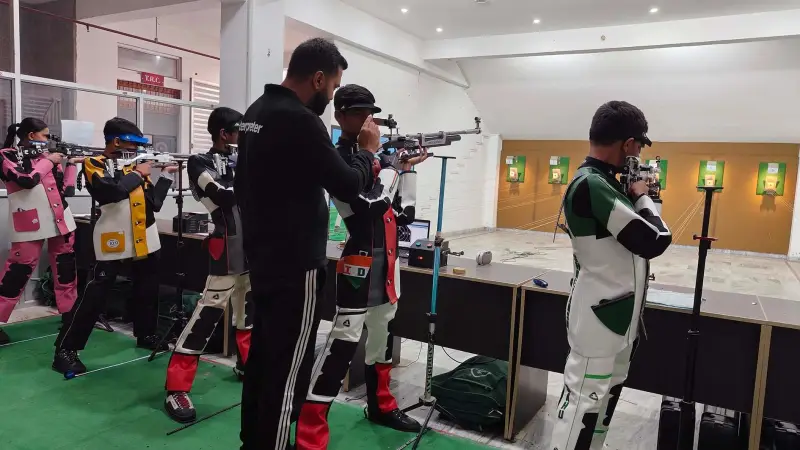
Genuine sports facilities create the conditions for genuine sporting development. They include adequate outdoor space for field sports — cricket, football, athletics — with properly maintained surfaces that are safe for children to play on at full intensity. They include indoor spaces for court sports, gymnastics, and year-round physical activity that is not dependent on the weather. They include equipment that is appropriate, sufficient, and regularly maintained. And they include qualified physical education teachers — not supervisors, not generalists pressed into PE duty, but educators who are trained in sport science, child development, and the specific pedagogical skills required to develop both physical capability and sporting character in young people.
Families in Prayagraj who are making the effort to specifically seek a school with sports facilities in Prayagraj are asking exactly the right question — because the presence or absence of genuine sporting infrastructure is one of the clearest indicators of whether a school has built a truly holistic educational programme or whether it has simply decorated a narrow academic offering with the language of whole-child development.
Sport and the Social Development of Children
One dimension of sport's educational value that is often underappreciated is its extraordinary power as a social development tool. Team sports, in particular, create conditions for social learning that the classroom — however well designed — cannot fully replicate. In a team, children must navigate genuine interdependence: their success depends on others, and others' success depends on them. They must communicate under pressure, resolve conflict in real time, and sustain relationships with people whose strengths and personalities differ significantly from their own.
These are precisely the social competencies that employers, universities, and communities most value — and most find lacking — in young people who arrive having spent their school years exclusively in academically focused, individually assessed environments. The child who has captained a team, who has learned to motivate struggling teammates, who has experienced the particular satisfaction of collective victory and the particular pain of collective defeat, arrives at adulthood with a social intelligence that is simply not available through any other route.
Individual sports — athletics, swimming, tennis, gymnastics — develop a different but equally important set of qualities: self-discipline, personal accountability, the ability to set goals and work toward them with sustained dedication, and the deep self-knowledge that comes from understanding one's own physical capabilities and limits. Both team and individual sport have essential roles to play in a complete physical education programme, and the finest schools offer genuine access to both.
Physical Wellbeing as an Educational Outcome
The conversation about sport in schools cannot be complete without acknowledging the physical health dimension — one that has become increasingly urgent as sedentary lifestyles, screen time, and processed food converge to create a childhood health landscape that would have been unrecognisable to previous generations. Childhood obesity, postural problems, poor cardiovascular fitness, and the early onset of lifestyle diseases are realities that schools can either compound through inactivity or actively counter through committed physical education programmes.
A school that genuinely prioritises sport is a school that is investing in its students' long-term physical health — building the habits of regular physical activity, the love of movement, and the understanding of the body's needs that children carry into adulthood. This is not peripheral to a school's educational mission. The body and the mind are not separate systems. A child who is physically healthy, active, and energised learns better, feels better, and engages more fully with every dimension of school life.
Where Every Child Gets to Play, Compete, and Grow
At Gurukul Montessori School, we have built our sports programme on the conviction that physical education is not a break from learning — it is one of its most powerful expressions. Our facilities provide students with genuine access to a range of sports and physical activities, supported by qualified coaches who develop not only athletic skill but the sporting character — discipline, teamwork, resilience, and personal best — that we believe every child deserves the opportunity to discover. We celebrate the student who runs their personal best as enthusiastically as the one who tops the mathematics examination, because we know that the qualities developed on the field are the same qualities that will define their success long after school is over. At Gurukul Montessori School, every child is an athlete, every game is a lesson, and every moment of physical effort is an investment in a stronger, more capable, more complete human being.
Gurukul Montessori School · Prayagraj · Strong minds, strong bodies, and the character to match.
Related Post




Recent post